Pages

Showing posts with label creative writing. Show all posts

Saturday, April 18, 2015

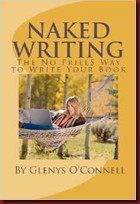
Saturday Snippets: First Chapter, Naked Writing!


By @GlenysOConnell

For years I taught creative writing in class, at third level, and online, and U;m happy to report that a number of my students went on to be published, som by very respected publishing houses. So when the time came to let go of this course - although I'd still accept a student or two if asked, because I have fun doing this - I decided to put it all in a book.

Naked Writing: The No Frills Way to Write Your Book, has been very successful because it covers the basics. I talk about genres, outlines, characters building, using settings, motivation, and a whole range of other stuff. The idea is to identify your novel's audience, create a logline for use in your pitches, outline the book
and then work on the first three chapters so you can continue to the end. It's all aimed at helping you understand the writing process and actually getting your book written using the assignments at the end of each chapter.

Readers can even email me if they need a little handholding on the way! So here we go - Chapter One of Naked Writing (and no, you don't have to be naked to read this!)


CHAPTER ONE


This first chapter looks at markets, audiences and publishers for
the sort of book you want to write, and at what kind of genre/category your
book fits into. It might seem odd to think of marketing before you've
written your book, but students of my writing course tell me that this exercise helps to focus you on your idea and to clarify what you want to do.

 Don't take this as meaning that you should try to write a book that fits with other books on the market. What it really means is to get to know what is already out there, who's buying what. This will give you an advantage when choosing the theme and voice of your book and determining freshness of your plot and story, among other things.

It's also the perfect excuse to go browse around the bookstores - and what writer can refuse that? If you can't get into an actual store, go online and visit Amazon, Barnes and Noble, etc. and look at the categories like mystery, romantic suspense, romance, thrillers, historical, women's literature, etc.
Whatever areas you are interested in. See what area the authors you like are filed in - as writers, we often write the kind of book we like to read!

KNOW YOUR GENRE

Go into any large bookstore and you'll be dazzled by the wide array of books, the subjects and the variety, all awaiting your eager purchase. But you're moving beyond being a mere bookstore browser - you're a writer and one day soon you're planning to
see your own book decorating those shelves. But what kind of book are you writing?

You can see from the shelves there that there are many different kinds. Are you writing mainstream? These are books with a more general appeal, as opposed to say, category romance. Mysteries, crime, literary, biography, docu-drama, science fiction,futuristic, military, gothic, horror, suspense, humour, fantasy, erotica….
.
There's even a section called Women's Literature. Yes, I know, I objected at first. After all, why should women's literature be separated out from Literature as if it's somehow inferior? But when you think about it, there are subjects dealt with in this genre that appeal specifically to women. Often they look at relationships, motherhood, sexuality, and survival in a patriarchal society. And the other bonus is that, if you're a woman writing a thoughtful literary novel unveiling some of the issues that intrigue or disturb you, you may well have an edge in getting published in this category.

Even most of the genres have sub-genres: detective novels, for example, have
'cosies', a sort of modern day English country house mystery, and 'hard-boiled' which is
the tough private-eye kind of story as made popular by Dashiel Hammett. Then there
are detective mysteries, which can be 'hard-boiled' or 'amateur'; police procedurals,
private eye novels, or law-and-order police types.

There are the category romances, which are a specialist genre in their own right.
If I were to say to you that I was reading a Harlequin Romance, you'd probably
immediately have a picture in your mind of a fairly sexy cover, and an idea of a book in
which the entire story usually revolves around the growing love relationship between a
hero and heroine (I say usually - there are many changes coming down the pipeline,
and some companies are publishing books for gay and lesbian relationships, etc. Not
Harlequin, Mills & Boon yet, though).

In these stories, everything comes secondary to the love relationship. However,
they are category romances because they can be split into categories: you have sweet,
sexy, hot, tender, and then you've got medical, suspense, paranormal….all crowding
together under the same general heading of category romance.

Now, the reason for knowing what genre your about-to-be-written book falls into
is not so that you can put out a cookie-cutter version of the latest best seller in that
genre. The idea is to find out what's already out there and who publishes it.
Also, consider the kind of books you enjoy reading. Writers often start out by
writing the sort of book they would like to read. List your favourite authors. It's important
for writers to read and keep up with current trends. Keep the receipts because in most
jurisdictions you can claim books, magazines, etc., as a business expense for your
writing. Even if you're making no money from your writing yet, most tax jurisdictions give
you a couple of years to get started, allowing you to claim tax relief on your expenses,
including your computer, travel, paper, workshops, etc.

Sometimes they may ask to see some evidence that you are writing seriously
and attempting to earn an income, so make sure you also keep copies of the letters you
will send out to publishers, and the replies you get - even the rejections count for
something in the taxman's eyes! Check with your local tax office for further details of
what you can claim.

CHAPTER ONE ASSIGNMENTS:

Writing Exercise One: Consider one or more of your favourite books, and
write a few sentences about what aspects appeal to you, specific reasons you
liked the book: was it story, plot points, characters, setting, genre….?
Writing Exercise Two: Going to the bookstore and browsing the books was
no hardship, right? But wait - there's more:

Take a note of the titles in the same general category or genre as the
one you plan to write. List their publishers, and if you can, copy down a couple of blurbs
from the back or inside cover. You know, the parts that offer a (usually) enticing couple
of paragraphs about the story, designed to lure you into buying. And by all means, buy a
book, or two or three.

Your next step is to look up the publishers on your list from the bookshop. Use
the Writers' Market or Writers' And Artists Yearbook if you have one - it's invaluable for
writers. You don’t need to buy a new one every year, but do remember that publishing
personnel can move around a lot between companies, so it's usually a good idea to
phone or check their Internet listing when you're ready to submit to ensure the editor in
the section you're targeting is still there. Or get the new editor's name, no matter how
recent your Writer's Market is. There is also an online version.You can also do online searches for the publishers' websites. Look for 'submissions' (it's sometimes hidden away under the 'contact us' or 'about us' buttons) You will find that many publishers don't accept submissions from unagented writers, which can be a bit of a catch 22 situation as it can be hard to get an agent interested
until you're published.

Look through the publishers' sites; look at what they're publishing now that's
similar to the sort of book you're planning to write. If you can get guidelines for
submissions, and if they tell you what they're looking for, you're streets ahead. Are they
looking for stories with lots of action? What level of sexual content predominates? Do
they have a lot of humour, or are there mostly dark, edgy titles?

Basically, familiarise yourself with the publishers' requirements, and keep a list
and notes - sometime soon you're going to be targeting these publishers. While you are
not going to be writing a book deliberately pushed into a specific shape to fit a publisher,
you are going to keep one eye on the market as you write. This way you can enhance
any aspects of your own work you perceive that publishers want. Keep these notes -
they'll help you when you start sending work off.

Naked Writing:The No Frills Way to Write Your Book is available from your nearest Amazon in print or ebook!

Tuesday, March 10, 2015

Wednesday’s Writing: Hook Your Reader-Cliffhanger Endings

@GlenysOConnell
womanwritingHello, Dear Readers – I’ve been lax with my blog for the last week or so, and I am so sorry. Sometimes things happen…but more about that in the next Monday’s Inspiration Blog!

Meanwhile, I talked about hook beginnings to grab your readers, and how they should happen at the start of chapters and scenes as well as the beginning. In that blog I promised to talk about the all important endings that make your reader want to read on from scene to scene, chapter to chapter. So here goes:

Each chapter starts with a hook, flows through the middle, and ends with a 'cliff-hanger'.

The term 'cliff-hanger' dates back to the old black and white movies - does anyone remember The Perils of Pauline? We've probably all seen references to these early adventures, although my guess is most of us are a bit too young to have seen them first run-through!

Pauline was the heroine in a series of movies where she went
through many trials and tribulations. At the end of each movie
Pauline was left in dreadful straits - tied to the tracks in front of a speeding train, hanging over a steep cliff by her fingertips, trapped in a runaway car speeding towards a flooded river……..


Each week faithful fans returned to the movie house to find out how Pauline was rescued from the latest terrible situation. And, of course, she was always rescued - she had to be back in her starring role the following week!

cliffhanger
That's what we call a cliff-hanger ending. You can probably already see why one of these at the end of each chapter would seduce your reader to glance at the first page of the next chapter to see how it all worked out - and the hook at the beginning of that chapter will keep her reading towards the next cliff-hanger….the next hook….and on into the wee small hours of the night!


It's a crafty way of keeping the tension up and drawing the reader more deeply into your story. The hook that follows a cliff-hanger does not necessarily have to be the segment of story immediately following the cliff-hanger - or the bit where Pauline is rescued. You can go to another thread of the story, but you must use a hook so the reader continues reading seamlessly as she knows she is being led to the moment when all the threads are pulled together at the end.


One caveat, however. The cliff-hanger ending does not apply to the very end of the book. This is where all the reader's questions are answered, and while your characters may not be guaranteed a happily ever after, they are at least generally out of danger, emotionally on solid ground again, and ready to get on with the next phase of their lives, having changed for the better due to the events and lessons they learned in
the story.


In other words, while the end of a chapter is meant to be exciting and raise questions about what happens next, the final end of the book is calming and answers all those questions.


Once you get into the habit of thinking of your chapters like this, it will come easily to you. Like magic!


Again, this blog is an excerpt from Naked Writing, the No Frills Way to Write Your Book! in the UK, or here for Canada, and here for the US, or in your region’s Amazon store.

Wednesday, October 22, 2014

Wednesday’s Writing: Creating Loglines


womanwritingWhat is a log line?  It’s the essence of your entire novel – or movie – boiled down to one or two sentences.

Sound crazy? Well, it’s not. Loglines have a lot of impact on your writing, as well as being a great device for when you’re in the elevator with the publisher, editor or agent whose attention you need to grab in 50 words or less!

The following is an excerpt from my book, Naked Writing: The No Frills Way to Write Your Book                !Naked Writing Cover
First of all, be brave. Write down your novel idea. How long is your description? A few pages? A page? Three paragraphs? A couple of sentences?
If your answer was the last option, a couple of sentences, then you're in luck. That's exactly what I want you to do - boil your entire story idea down into two or three crisp, bright sentences. This usually sets students off into groans and moans, but later when they realize what a valuable exercise it is, they're delighted.

Why should you express your idea in so few words? Several reasons:

1) You want to know how strong your idea is. Will it last the course?
If you are able to write it down in two or three sentences, and it still makes sense and sparkles brightly, then you can be fairly sure you've a workable idea. If not, it might be that you need to set it aside until other parts of the puzzle pop into your head.

I always keep an ideas file on my computer. I used to just scribble down notes, but in the end I had several purses crammed with bits of paper, receipts, and paper napkins, all with unintelligible scribbles that once were great ideas. I still scribble down ideas when they come to me - but as soon as I can, I type them into my computer file. Funnily enough, by the time I do this I have a lot more detail for the idea.

Antidote for a Weak Idea: Set it aside in your Ideas File, and read it every now and again - strengthening additions will occur to you. Look at your file to see if any other ideas can be merged to form a stronger whole. Ideas do not arrive in our heads fully formed, sometimes they come in bits and pieces and the smart writer is alert enough to capture them as they arrive.

2) Now you have this one paragraph mini outline. It keeps you focused on your story. Write it out on sticky notes and apply to your computer monitor, your diary - even the bathroom mirror if you dare!

3) This short form is your pitch to an editor or agent. In screenwriting, it's called a 'logline' and is used to capture the attention of producers and directors. In our case, we're going to nurture this simple paragraph, use it at the beginning of query letters and as the basis for the synopsis which is our selling tool when the book is finished and ready to do the rounds of publishers and agents.

See how useful this logline is? So how do you do it?

Take the most important part of your idea, add the names of the two main characters, and describe the problem they must overcome. Here are some examples from well known books:
Consider these:
A young couple fall in love and vow to remain together despite the opposition of their families and an edict from the ruling prince, but a misunderstanding brings about tragic consequences - Romeo and Juliet

A rebel leader goes up against the might of Rome, is betrayed by his own people, and is martyred. But his teachings of love and peace live on and are still celebrated 2000 years later – Jesus Christ, The New Testament

A man and woman struggle against powerful opposition to solve the riddle of an ancient code and find a precious artifact. They learn the truth about it, and in doing so they learn the truth about themselves and fall in love. But they face a dilemma when they find the artifact and realize the dangers it could pose. - The Da Vinci Code

A man whose family has worked a piece of land for generations believes it should be his, and is willing to kill to hold onto it. But his stubbornness results in the death of his only surviving son and he is left to question the true value of the land he so coveted - The Field.

Try it – I guarantee when you see how much this exercise clarifies your novel or non-fiction idea, and how useful it can be as part of your pitch, query letter, and later on, promotion, you’ll learn to love loglines!
                             And here’s a bit of shameless self-perf5.000x8.000.inddpromotion: My latest romantic suspense, Another Man’s Son, is now out in print. It’s part of the delightful Lobster Cove series from The Wild Rose Press, and you can read the first chapter on my website here.